



🌱 Plastic-Free Tableware | Sustainable Packaging & Foodservice Solutions

1️⃣ Applications, Advantages & Standards
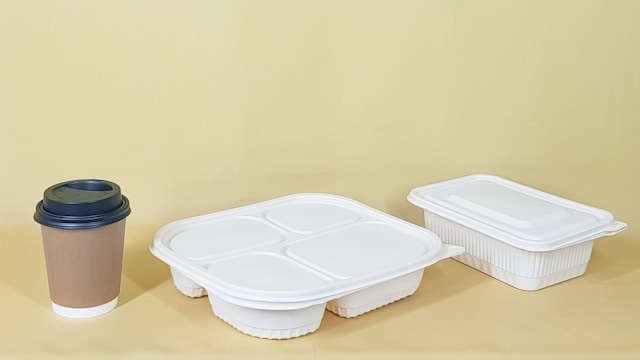
Plastic-free tableware is widely used across foodservice, catering, takeaway, and ready-to-eat (RTE) packaging.
These products are plastic-ban compliant, compostable, and recyclable, making them ideal for eco-conscious businesses.
All materials comply with EU, FDA food contact, and EN 13432 compostability standards.
🔸 Key Benefits:
- Suitable for foodservice, beverages, and takeaway packaging
- Compostable under industrial composting conditions
- Certified for direct food contact (EU/FDA/EN 13432)
- Environmentally friendly and brand-positive
2️⃣ Limitations & Challenges
Despite the clear benefits, plastic-free tableware faces several technical and economic challenges:
- Higher production costs than PE-coated alternatives
- Reduced barrier performance against humidity and oils
- Recyclability limitations for certain biopolymers
- Need for proper composting infrastructure
- Limited heat resistance (typically below 90°C)
However, continuous innovations in coating technologies—such as nanocellulose and mineral-organic blends—are helping overcome these challenges.
3️⃣ Market Trends & Opportunities
The market for plastic-free tableware is expanding rapidly due to regulatory drivers and consumer demand for sustainability.
Legislations like the EU Directive 2019/904 and plastic bans in Canada and India are accelerating adoption.
🔹 Innovation Highlights:
- Nanocellulose coatings improving moisture and grease barriers
- Water-based and mineral-organic coatings for enhanced performance
- Integration into the circular economy through fiber recovery
- Growing eco-brand adoption by companies like Starbucks and McDonald’s
These advancements are reshaping the global packaging landscape toward a plastic-free future.
4️⃣ Conclusion & Outlook
Plastic-free tableware continues to evolve with new biomaterials, advanced coatings, and supportive regulations.
While challenges such as barrier durability and end-of-life processing persist, innovative technologies like nanocellulose and dispersion coatings are paving the way for sustainable and scalable solutions.
🎬 Final Message
Plastic-free tableware represents more than a trend—it’s a key solution for reducing plastic pollution and achieving a sustainable circular economy in the food industry.
With continuous innovation, better composting systems, and global brand adoption, the future of food packaging is truly plastic-free.
That was insightful! I would like to be in touch with you in this regard.